• Hello there guest and Welcome to The #1 Classic Mustang forum!
    To gain full access you must Register. Registration is free and it takes only a few moments to complete.
    Already a member? Login here then!

Need help with balancer timing marks

Bad66GT

Banned :)
Donator
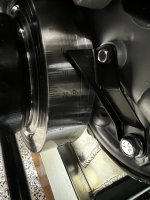
@PSIG and others. My ProFlow wants this. 12 degrees BTDC.

Unfortunately my balancer, Ford Racing M-6316-C351 only has TDC. No markings before.

IMG_9089.png


I currently have it at 0 degree TDC. I don’t think I’ll have an issue starting it but want to get it dialed in correctly.

Any help is appreciated. :)

Chris
 
FIRST, establish absolute, true, TDC using a "Piston Stop Tool". Mark the balancer appropriately. If you're "lucky" it'll match the TDC mark already there. Next, determine your balancer's circumference at the timing scale. For example, if your balancer is 6-3/8 inches in diameter, the circumference will be Pi (3.1415926) times the radius (3-3/16 inch) squared (10.16015625) then divide by the number of degrees in a circle (360) and multiply times the desired advance (12) to obtain a measurement of .338671875 inch. Since the crankshaft rotates CCW (looking from the front), timing advance would ALSO be in that same direction, so measure 11/32 inch in that direction from "TRUE TDC" and scribe/paint a mark there.
 
Looking at it from the front isn't the balancer spinning clockwise? If the woodruff key locks the balancer at the crank how can TDC be off? I thought that one was dummy proof. Timing light blinks on #1 spark, shows on the balancer where your crank/piston is. I get that is is rudimentary, so bear with me if I have all that wrong
 
Looking at it from the front isn't the balancer spinning clockwise? If the woodruff key locks the balancer at the crank how can TDC be off? I thought that one was dummy proof. Timing light blinks on #1 spark, shows on the balancer where your crank/piston is. I get that is is rudimentary, so bear with me if I have all that wrong
It is clockwise....I had to think it through and once I started it, it was verified. :) So my 12 on my balancer is 12 degree BTDC. :)

Chris
 
Looking at it from the front isn't the balancer spinning clockwise? If the woodruff key locks the balancer at the crank how can TDC be off? I thought that one was dummy proof. Timing light blinks on #1 spark, shows on the balancer where your crank/piston is. I get that is is rudimentary, so bear with me if I have all that wrong

Balancer be machined a little off, marks be in wrong place, pointer could be off, key way on crank machined off.
 
I would assume that any facility capable of machining to thousandths of an inch would be able to nail that! But I guess it's always better to verify. I mean even with the timing light. once it is spinning 3,000 rpm the actual point in time is subject to the viewer. I used my phone to make a video, then paused it on the exact flash event. Just for my own edification, but in the combustion cycle what's 1 degree either way
 
I would assume that any facility capable of machining to thousandths of an inch would be able to nail that! But I guess it's always better to verify. I mean even with the timing light. once it is spinning 3,000 rpm the actual point in time is subject to the viewer. I used my phone to make a video, then paused it on the exact flash event. Just for my own edification, but in the combustion cycle what's 1 degree either way

It's called tolerance stack, balancer off a few thousandths, marks off a hair, crank key way off a few thousands, pointer bent or cast off just a hair. Its the reason we degree cams, and don't just take them to be correct when installed. On facebook one guy posted that a new BTR cam he just bought had a miss machined area where the cam shaft retaining plate went and the plate couldn't be installed. Stuff happens all the time.
 
Use piston stop. Rotate one direction till bind , mark it on balancer. Then rotate it other direction till bind , mark also on balancer . The middle of those two marks is absolute TDC . Calculate circumference and find a timing tape decal to put on your balancer. Like from MSD.
 
I would assume that any facility capable of machining to thousandths of an inch would be able to nail that! But I guess it's always better to verify. I mean even with the timing light. once it is spinning 3,000 rpm the actual point in time is subject to the viewer. I used my phone to make a video, then paused it on the exact flash event. Just for my own edification, but in the combustion cycle what's 1 degree either way
Don't forget that the balancer is two pieces and with each degree on an average balancer reflecting only around .036" in distance around the balancer it's not hard to be "off".
 
If the woodruff key locks the balancer at the crank how can TDC be off? I thought that one was dummy proof.
Ah, unfortunately no. Multiple factors come into play, from production tolerances of the keyway, the balancer ring placement, the marks on the ring, the pointer and its bolt holes, the timing cover pointer holes, blah, blah... Beyond that things like damper age where the ring (with its marks) can slip and rotate to any position, and so on.

The solution is to test (as Bart said) with a piston stop tool in the spark plug hole. Quick and easy. They are under $10 if you shop around, sexy ones more, or make your own for almost free. I always check TDC on every build, and re-mark if necessary. If using timing marks for reference, they have to be accurate.

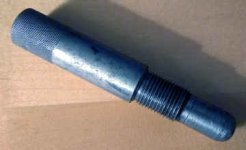
My simplistic home-made piston stop tool:
Simple Homemade piston stop.jpg

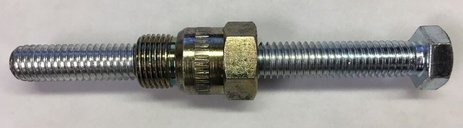
Others use a gutted spark plug body and a bolt, or other schemes. Or spend a few bucks:
DIY piston stop tool.jpg
Original source unknown


[EDIT] Why not just put stick in the hole and stop when it hits "top" to check TDC? Because around TDC on a 302, an error of only 0.050" can put the crank in a 30° range (14.9° BTC to 14.9° ATC). :oops:


My ProFlow wants this. 12 degrees BTDC.
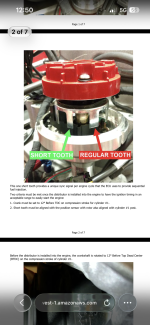
To repeat - verify TDC marks, set crank to 12° BTC, rotate distributor body to align the center of the sensor to the edge of the correct tooth. Done. If it's not perfect, it will be really close. Lock your timing in settings (so timing isn't moving), start it up, and check final with your timing light (rotate body to match commanded timing, or in some systems change the 'trigger offset' so it matches commanded timing).
 
Last edited:
Ah, unfortunately no. Multiple factors come into play, from production tolerances of the keyway, the balancer ring placement, the marks on the ring, the pointer and its bolt holes, the timing cover pointer holes, blah, blah... Beyond that things like damper age where the ring (with its marks) can slip and rotate to any position, and so on.

The solution is to test (as Bart said) with a piston stop tool in the spark plug hole. Quick and easy. They are under $10 if you shop around, sexy ones more, or make your own for almost free. I always check TDC on every build, and re-mark if necessary. If using timing marks for reference, they have to be accurate.

My simplistic home-made piston stop tool:
View attachment 68945

Others use a gutted spark plug body and a bolt, or other schemes. Or spend a few bucks:
View attachment 68944
Original source unknown


To repeat - verify TDC marks, set crank to 12° BTC, rotate distributor body to align the center of the sensor to the edge of the correct tooth. Done. If it's not perfect, it will be really close. Lock your timing in settings (so timing isn't moving), start it up, and check final with your timing light (rotate body to match commanded timing, or in some systems change the 'trigger offset' so it matches commanded timing).
I think I was really close with everything being new...again, like you said, degree-ing a cam happens because stuff. As you may or may not have seen it fired first time. Once the o2 sensor is hooked up, Ill get the system better aligned to the new engine and then see what this engine is all about.

Chris
 
Back
Top