From what I understand, the change wasn't an issue of engine positioning, it was of mount strength.
Ford engine mounts have 2 components -- a frame mount, which bolts directly to the subframe, and a motor mount, which is the steel and vulcanized rubber part that connects the engine to the frame mount. We typically refer to this second component as the engine or motor mount, but it is really both components that make the mount.
I suspect Ford responded to reports of the rubber engine mounts tearing under hard acceleration, so they updated them in late 65. The frame mount was originally a cast piece. It was in turn bolted to the rubber and steel motor mount, which was a simple piece of steel with a vulcanized rubber pad:
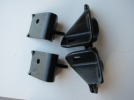
Both components were updated in late 65. The frame mounts (the cast iron pieces) were replaced by a new stamped steel piece and the motor (rubber) mount was replaced with a beefier steel and rubber part. This later mount style was supposed to not only be stronger -- but they raised the engine just a bit. Header clearance improvement was probably an unintended result of the redesign.
I need to know how much additional clearance is provided by use of the new style mounts.


